On MS NOW’s Morning Joe today, Steve Rattner charts the data showing Trump’s failures to balance the budget and bring jobs back home.
Promises made, promises not kept. President Donald Trump returned to office 18 months ago with a commitment to improve the economy in a variety of ways, from sharply curbing the deficit to getting the price of gasoline down to $2 per gallon. While the economy continues to grow and (most months) add jobs, all of that is happening more slowly than Trump promised and has been significantly aided by the artificial intelligence boom that the president has had virtually nothing to do with.

Start with the deficit. When Trump arrived, the deficit was $1.8 trillion (modestly lower than it had been the previous year). Now, even after adjusting for inflation, it is up to $1.9 trillion and projected to remain there for a few years until rising steadily to $2.5 trillion in 2036 (also after adjusting for inflation). As a share of the size of the economy (gross domestic product), the gap is projected to hover at or above 6%, compared to 3.4% in 2017. How did this happen? Mostly via the One Big Beautiful Bill, which extended many of the tax cuts passed in 2017 during the first Trump administration.
Not surprisingly, the continued high (and rising) deficits has pushed the national debt upward. It has already passed 100% of GDP and is projected to exceed the 1946 post-World War II record of 106% of GDP around 2030. That is two years sooner than what the Congressional Budget Office projected before the OBBB passed last year. By 2035, this important ratio could reach 120%.

Among Trump’s promises was that he would sharply cut federal spending via the now famous (or infamous) Department of Government Efficiency, run by Elon Musk. DOGE was tasked with cutting federal spending by “at least” $2 trillion without any specified timeline. But when DOGE essentially shut down, it only claimed $215 billion in savings. Even that was suspect as a compilation of the “receipts” that DOGE offered only totaled around $35 billion according to third-party analysis.
Another promise that hasn’t worked out for Trump was that his tariffs would generate “literally trillions of dollars” of revenues. For that, Trump can thank the Supreme Court, which struck down many of his levies. Now the government has to provide refunds, which some experts have estimated could add up to nearly $200 billion.

On another front, Trump’s promise to bring back manufacturing jobs and increase factory construction has also not unfolded as promised. Indeed, the number of manufacturing jobs has dropped by 75,000 since Trump took office. Some of that reflected a continuation of a trend that began in early 2023. But it also resulted from the effect of Trump’s tariffs, which raised the cost of key inputs like steel and aluminum, causing U.S. manufacturers to cut back.
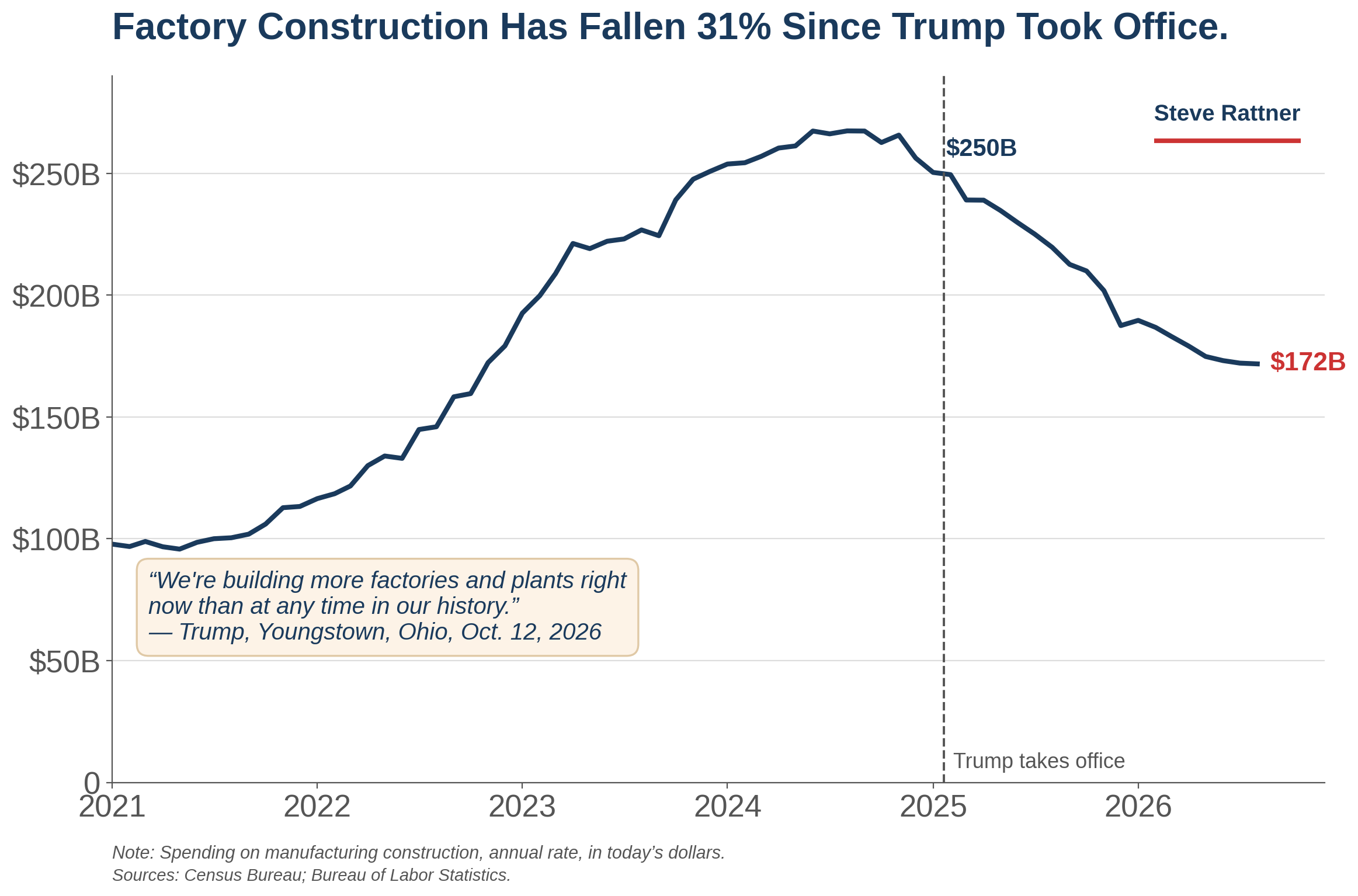
Similarly, the dollar value of factory construction has dropped to an estimated $175 billion on an annualized basis as of May of this year from $250 billion in November 2024. Again, policy changes ranging from tariffs to sharp cuts in clean energy subsidies played an important role as did the tailing off of the effects of the CHIPS Act, which stimulated construction of semiconductor plants. Trump likes to cite the upsurge in data center construction, but his policies had little, if anything, to do with this increase and in any event, that increase doesn’t come close to offsetting the drop in new manufacturing facilities.