Today on Morning Joe, Steve Rattner provided an update on strong fundraising from Dem candidates that still pales in comparison to Trump’s Super PAC funds.
The 2026 midterm elections are in full swing and as usual, candidates are campaigning not just for votes but also for the funds needed to mount the ever-escalating cost of a campaign. Party committees and political action committees will continue to play a major role in the money race. And for the first time, the election will be fought under a somewhat amended set of rules, thanks to a Supreme Court ruling handed down at the end of June.

Campaigns access funds from three principal sources: direct contributions, funds from party committees and the efforts of political action committees. When it comes to money raised directly by candidates (which is limited to $3,500 per person for primaries and another $3,500 per person for general elections), Democrats are in the lead. As of June 30, Democratic House candidates had a total of $438 million on hand, compared to $386 million for Republicans. Similarly, Democratic Senate candidates had $210 million in the bank compared to just $121 million for Republican candidates. Democrats similarly lead in funds amassed by traditional political action committees, where donations are limited. But when it comes to party committees, where effective donation limits are in the hundreds of thousands per year, and super PACs, which operate with no limits, the picture is reversed.
Donations to candidates are generally more valuable because they can buy television time at discounted rates whereas traditional PACs can accept money while coordinating directly with candidates. In addition, until the recent Supreme Court decision, neither party committees nor super PACs could freely coordinate their activities with those of the campaigns. But now party committees can do so without spending limits, which makes their ability to receive almost unlimited donations more valuable.

When it comes to the most closely fought Senate races, Democrats are generally excelling. Jon Ossoff, a Georgia incumbent, had $42.6 million on hand on June 30, compared to just $2.1 million for his Republican challenger, Mike Collins. Similarly, James Talarico, a Texas challenger, reported $21.5 million of cash while his opponent Ken Paxton (who fought a tough primary with incumbent John Cornyn) had just $1.8 million. Likewise for Roy Cooper in North Carolina and Sherrod Brown in Ohio.

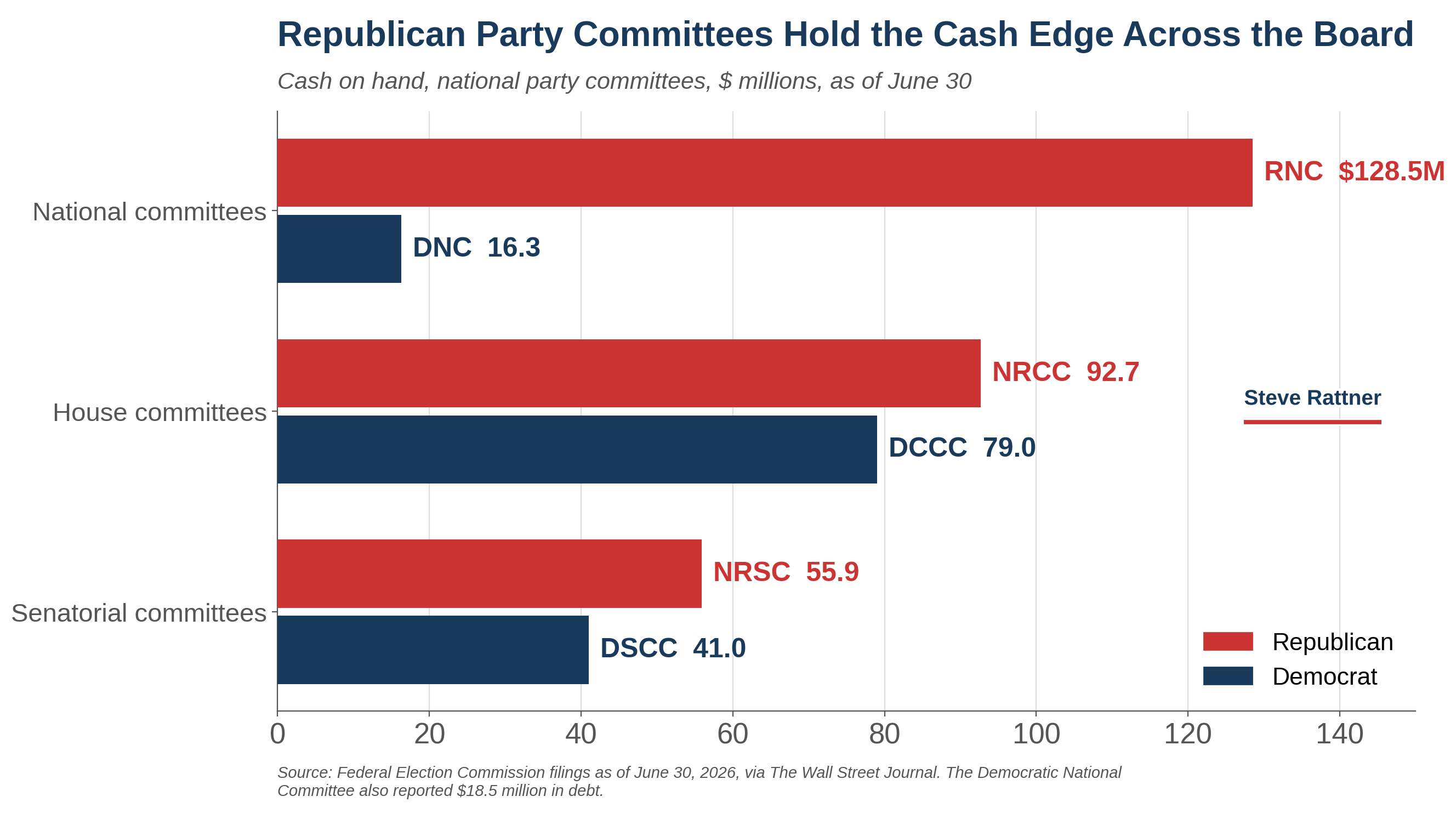
The disparity in funds on hand is largely made up for by the huge amount of cash reported by the Republican National Committee compared to just $16 million for the Democratic National Committee. In addition, the DNC had $18.5 million of debt while the RNC was debt free. The DNC has become an object of scorn among party regulars, in part because of its botched “after action” report. When it comes to the House and Senate committees, Republicans also lead, although by relatively modest margins.

As for Super PACs, the money race isn’t even close, in large part because of the huge war chest amassed by Donald Trump (part of why so many Republican candidates kowtow to him). Trump controls more campaign money than the House and Senate Republican Super PACs combined. But even putting Trump aside, Democrats still trail. (Democracy PAC II is George Soros’s Super PAC.) Note that the Supreme Court decision did not change the requirement that campaigns not coordinate with Super PACs.

Putting it all together, the 50 biggest donors have donated a total of $1.6 billion into these various buckets. Among those donors, the vast majority of the money has gone to Republicans, $1.05 billion compared to just $362 million to Democrats.

That disparity is even more pronounced among the very biggest donors. While George Soros was the biggest single donor at just over $100 million, nine of the 10 largest individual donors directed their money toward Republicans. Interestingly, half of the 10 largest contributors earned their fortunes in the technology or cryptocurrency industries. Some, like Marc Andreessen, had been major contributors to Democrats in past cycles.