Today on Morning Joe, Steve Rattner broke down who profits and who pays under Trump’s Iran deal — and how it compares to Obama’s 2015 nuclear agreement.
As the United States anvd Iran arm wrestle toward an agreement to end the war, the current state of play suggests an outcome that will deliver more financial and other benefits to Iran — and do so sooner — than did the Barack Obama deal (the JCPOA) that Donald Trump has been deriding for years.
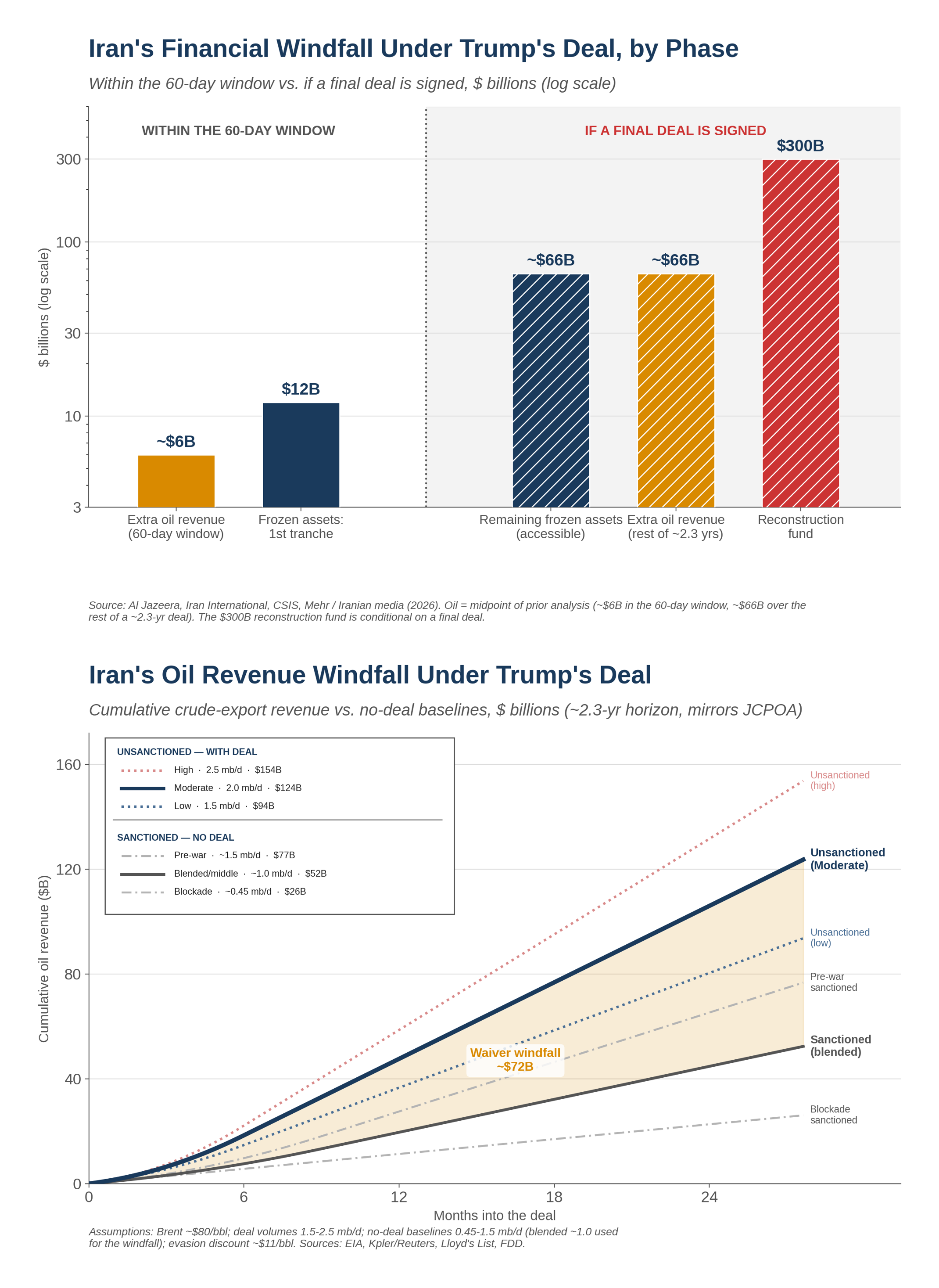
For starters, Iran has already been relieved of the sanctions on its oil sales, a move that is expected to provide Iran with an extra $6 billion of revenues just during the 60-day negotiating period. And Iran will have $12 billion of its frozen assets released before a final deal is agreed to. (Neither of these happened before the JCPOA was signed.) Then, over roughly the next two years, Iran would garner an estimated $66 billion of additional revenues as well as about $66 billion in unfrozen assets. Unresolved is who specifically would contribute to the $300 billion fund for reconstructing Iran that has been floated. (The Trump administration claims it has identified private donors in the U.S., Gulf States, and other countries, but no specific entities have been identified.)
All told, by having sanctions lifted on its oil sales, Iran could receive anywhere from $47 billion to $96 billion in extra oil money, roughly comparable to what it received during the 2.3 year life of the JCPOA.
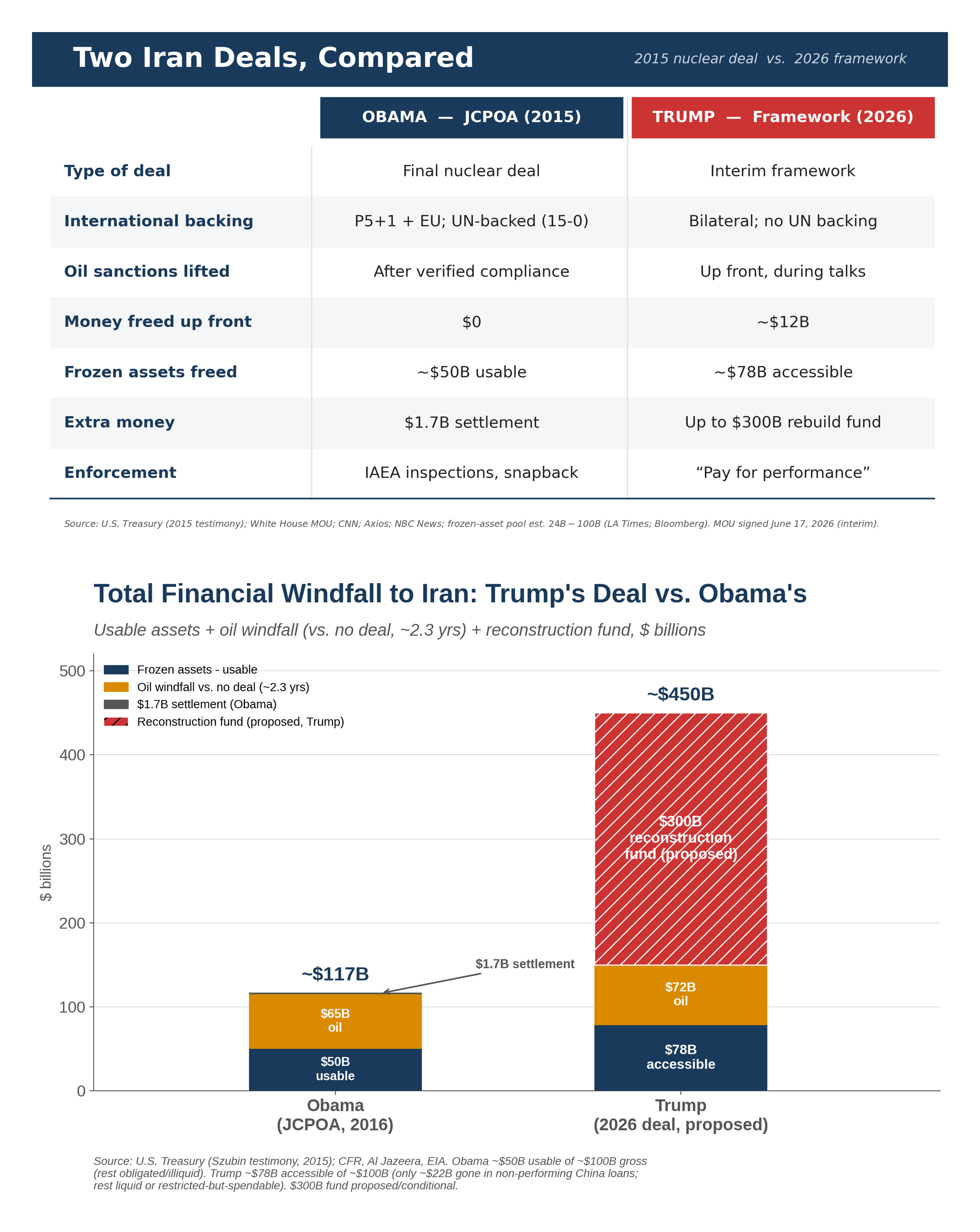
A side by side comparison of the two deals shows stark differences. Obama did not afford Iran any sanctions relief until the JCPOA was signed; some of Trump’s relief has already occurred. Obama ultimately unfroze about $50 billion of “usable” Iranian funds; this time, because the amount of their frozen assets has grown, Iran could receive nearly $80 billion. On top of all that, Obama released a small $1.7 billion of Iranian claims that were frozen at the time of the Iranian revolution in 1979; this was the planeload of cash that Trump loves to talk about. As for the current negotiations, we don’t know yet what else Trump may do, particularly about the $300 billion reconstruction fund. Lastly, Obama’s deal was enforced by international inspectors; Trump officials have talked without specificity about linking release of Iranian assets to compliance with a nuclear deal.
Adding it all up, Obama provided Iran with $117 billion in return for agreeing to the JCPOA; Trump is offering at least $150 billion and possibly more depending on the fate of the $300 billion reconstruction fund.
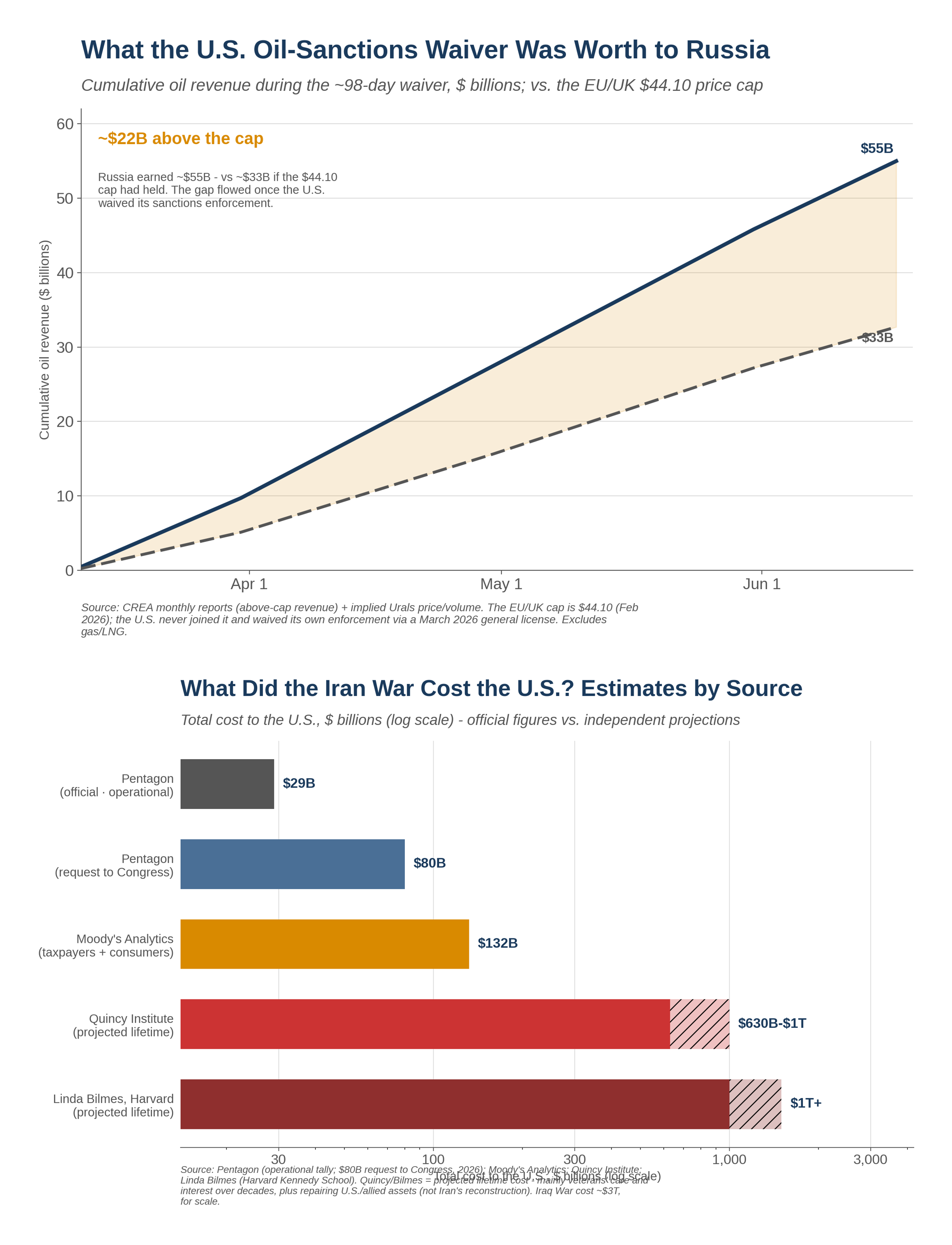
Two important collateral effects of Trump’s war on Iran. In order to maximize oil supplies, the president relieved Russia of the price cap that had been imposed on that country’s exports as punishment for its invasion of Ukraine. That has provided Russia with an estimated $22 billion in oil revenue just during the 98-day period the price cap was suspended.
Lastly, there is the cost to the U.S. of the war. While the Pentagon has pegged this number at $29 billion, it has asked Congress for a special appropriation of $80 billion, tacitly acknowledging the irrelevance of the lower figure. Meanwhile, one private forecaster — Moody’s Analytics — has put the likely total at $132 billion while two other experts think the tab could ultimately reach as much as $1 trillion, once costs like veterans’ benefits and rebuilding damage to American bases are incorporated.