
On Morning Joe, Steven Rattner broke down the latest campaign financial disclosures ahead of the midterms.
With two weeks to go before the midterms, the Democrats’ momentum shows up not only in the polls but in their candidates’ fundraising, despite a massive Republican advantage in PAC cash. Democratic candidates are raising money at a pace that has left their Republican opponents far behind – in some Senate races by a factor of five or ten. But candidates are only one part of the picture. Add in the party committees and, above all, the super PACs, and the Republican money machine is bigger and better stocked for the final stretch.
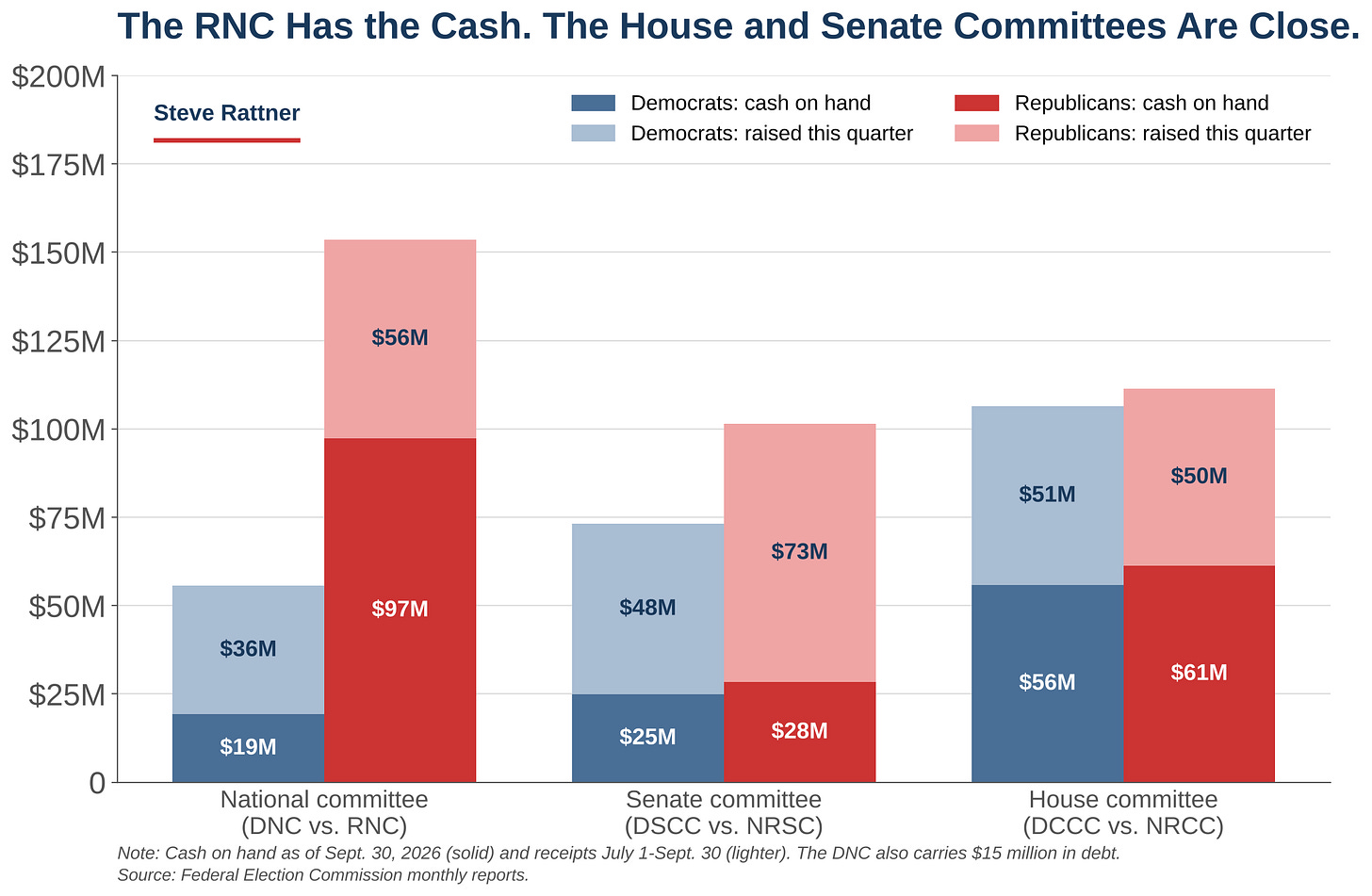
Looking first at the party committees, the Republican National Committee ended September with $97 million in the bank, five times the $19 million held by the Democratic National Committee – which also carries $15 million of debt. When it comes to the congressional campaign committees, the race is far more even. The two House committees are close, with the National Republican Congressional Committee at $61 million and its Democratic counterpart at $56 million. So are the two Senate committees, at $28 million for the Republicans and $25 million for the Democrats, after both spent heavily on ads in September. Third-quarter fundraising tells a more mixed story. The House committees were essentially tied, at $51 million for the Democrats and $50 million for the Republicans. But on the Senate side the NRSC out-raised the DSCC $73 million to $48 million, thanks to a $51 million September – much of it transferred in from joint fundraising accounts – and the RNC raised $56 million over the quarter against $36 million for the DNC.
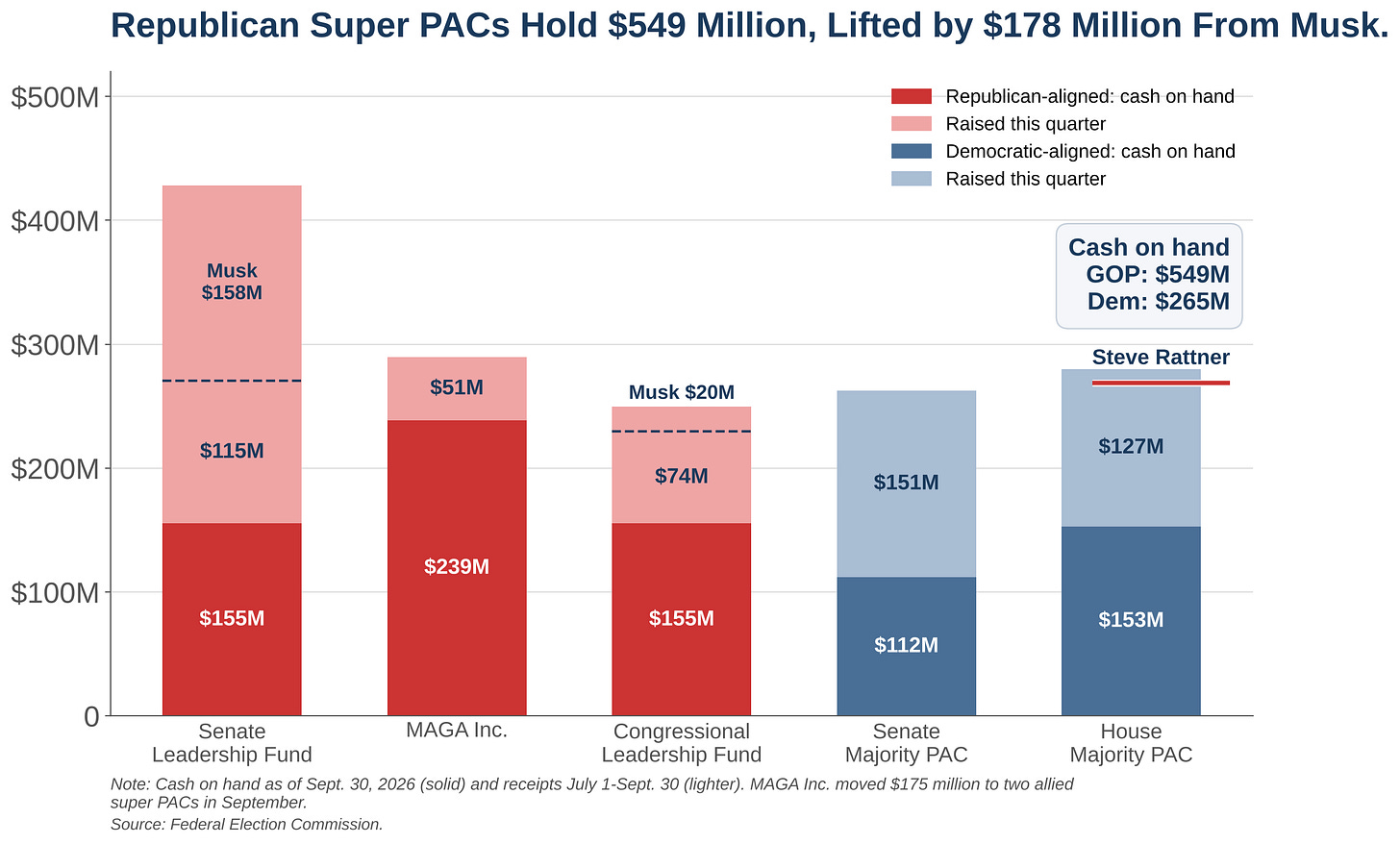
The real Republican lead comes from super PAC money, with one man playing a disproportionate role: Elon Musk. The Senate Leadership Fund, the main super PAC for Senate Republicans, raised $273 million in the third quarter, an unprecedented sum. $158 million of that came from Mr. Musk, in two checks written in September. He also gave $20 million to the House Republican super PAC and $88 million to his own America PAC, bringing his total for the cycle to $276 million – almost exactly what he spent getting Donald Trump elected in 2024. Then there is MAGA Inc., Mr. Trump’s personal super PAC, which until September had barely begun to spend. Last month it put $201 million to work, including $175 million shifted to two newly created Trump-aligned super PACs that are now blanketing the Senate map, and it still ended the month with $239 million in the bank. All told, the big Republican super PACs hold $549 million, more than twice the $265 million held by the two main Democratic groups – and that is before counting the $175 million now sitting with Mr. Trump’s new groups.
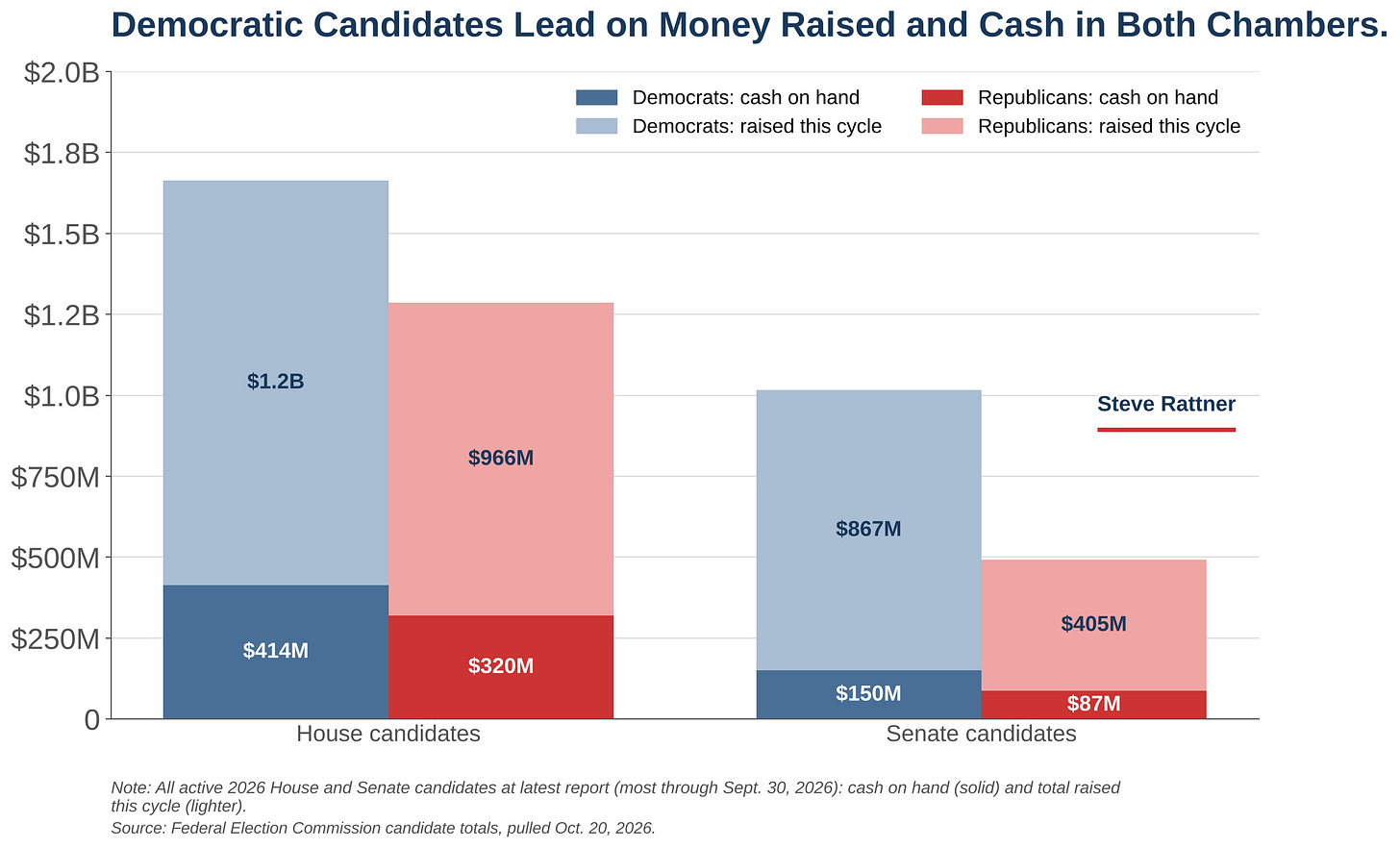
Democratic candidates themselves, on the other hand, have posted far stronger fundraising numbers for their own campaigns than their Republican competitors. Democratic House candidates have raised $1.25 billion this cycle to $966 million for Republicans, and hold $414 million in cash to the Republicans’ $320 million. The Senate gap is wider still: $867 million raised by Democrats against $405 million, with Democratic Senate contenders reporting $150 million in the bank versus $87 million. According to The New York Times, Democrats out-raised Republicans in 38 of the 42 most competitive House contests last quarter. And candidate dollars go further than super PAC dollars: by law, candidates are entitled to the lowest advertising rates, while outside groups pay whatever the market will bear, often several times as much. So the Republican advantage in outside money buys less airtime than the raw totals suggest.
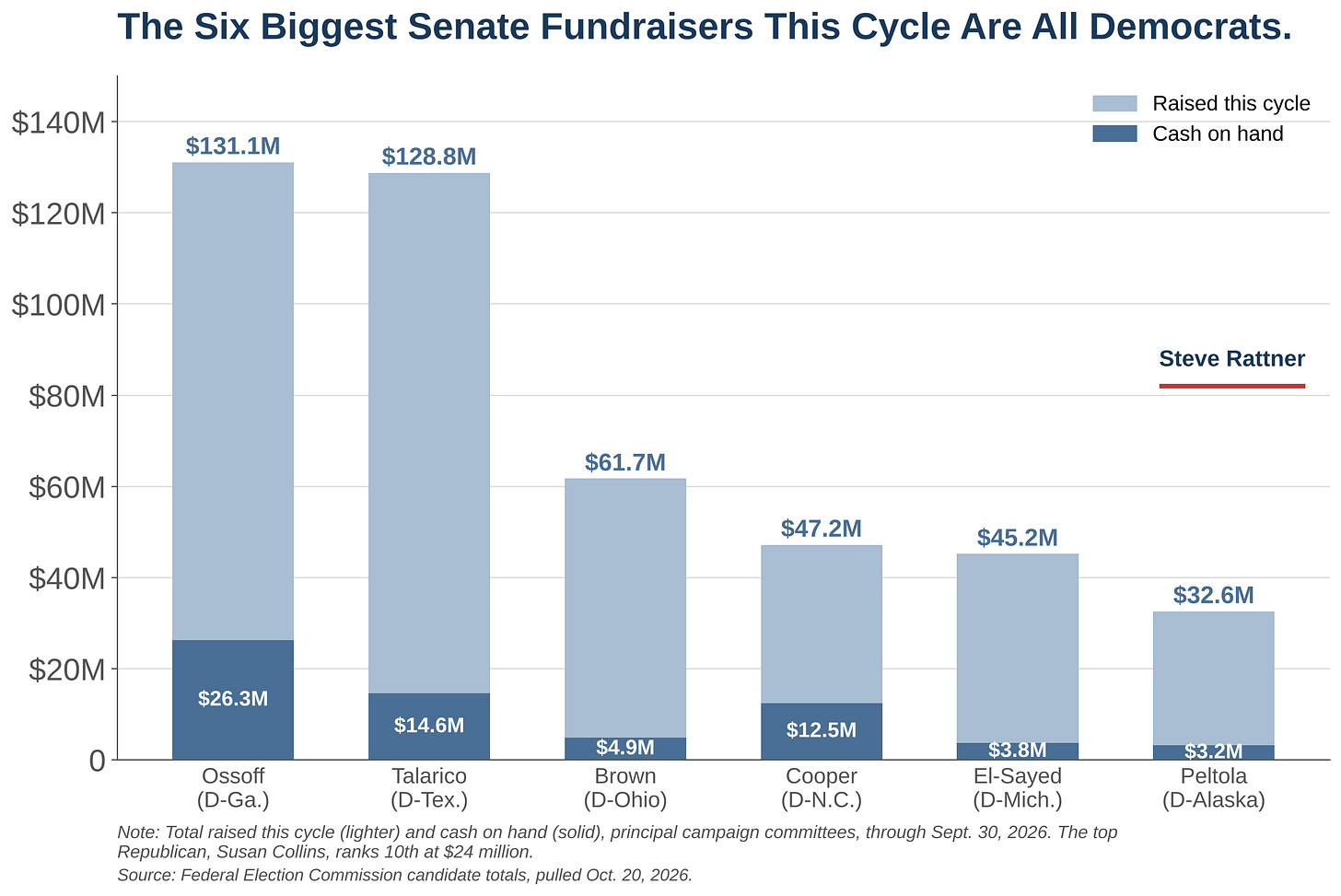
The Senate numbers are where the Democratic surge is most striking. The six biggest Senate fundraisers in the country this cycle are all Democrats: Jon Ossoff in Georgia ($131 million), James Talarico in Texas ($129 million), Sherrod Brown in Ohio ($62 million), Roy Cooper in North Carolina ($47 million), Abdul El-Sayed in Michigan ($45 million), and Mary Peltola in Alaska ($33 million). The top Republican, Susan Collins, ranks tenth at $24 million. Mr. Talarico alone raised $60 million between July and September, the most any Senate candidate has ever raised in a third quarter. The catch is that Democrats are spending it almost as fast as it arrives: Mr. Talarico spent $67 million last quarter and Mr. Brown $34 million. In Ohio, Michigan, Maine, Iowa, and Alaska, the Republican candidate began October with more cash on hand than the Democrat.
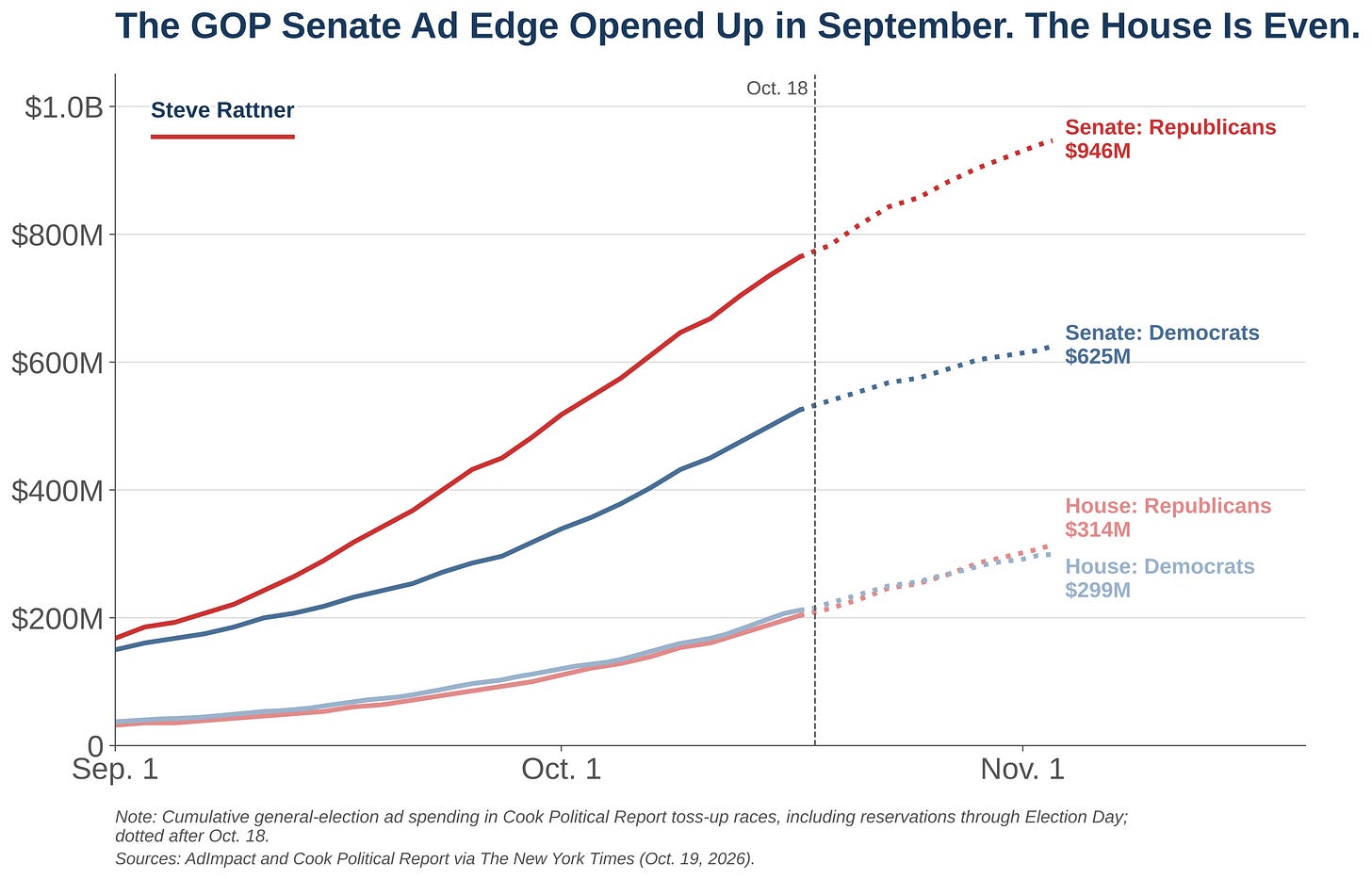
The biggest cost that all this fundraising underwrites is television advertising, and Republicans have put up more dollars to secure airtime. In the seven Senate races that the Cook Political Report rates as toss-ups, Republicans have aired or reserved $947 million of advertising to the Democrats’ $625 million, a gap of more than $320 million, and one that opened up almost entirely in September as Mr. Musk’s money reached Texas. In the 21 House toss-ups, by contrast, the two sides are essentially tied at about $300 million apiece, with Republicans ahead by only $14 million. This divergence reflects a strategic choice: many Republican donors and consultants have concluded that the House is no longer in play, and are doubling down on protecting their majority in the Senate.
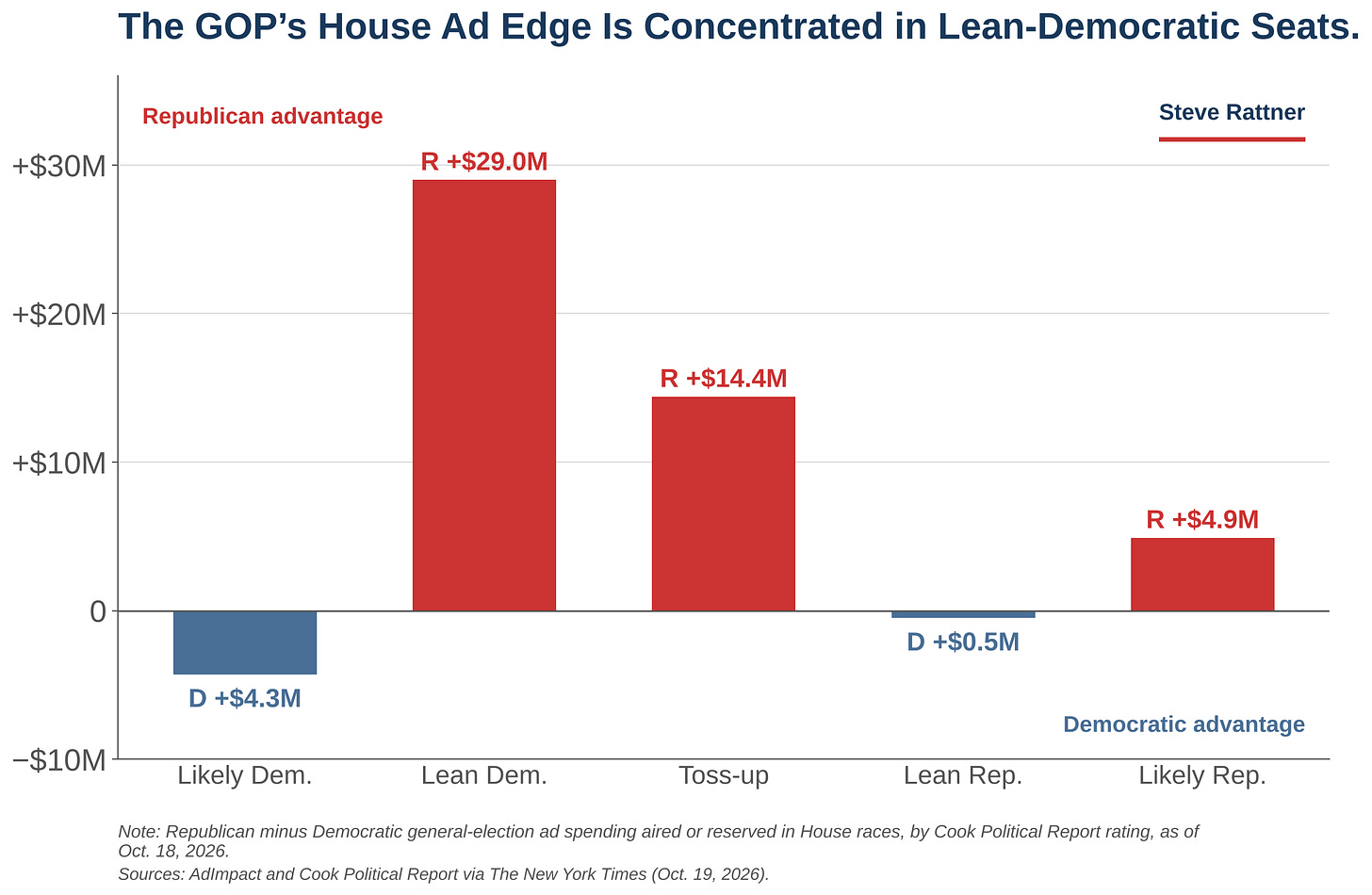
Even so, Republicans are ahead in ad spending in most categories of competitive House races. They are outspending Democrats by $29 million in the dozen seats that Cook rates as leaning Democratic and by $14 million in the toss-ups. In the seats leaning or likely Republican, the two parties are within $5 million of each other. In other words, the Republican money in the House is being spent on offense in Democratic territory rather than on defending their own members. Whether that offense pays off is another question. The polls suggest Republicans are unlikely to take much of that ground, but we will know for sure on November 3.